
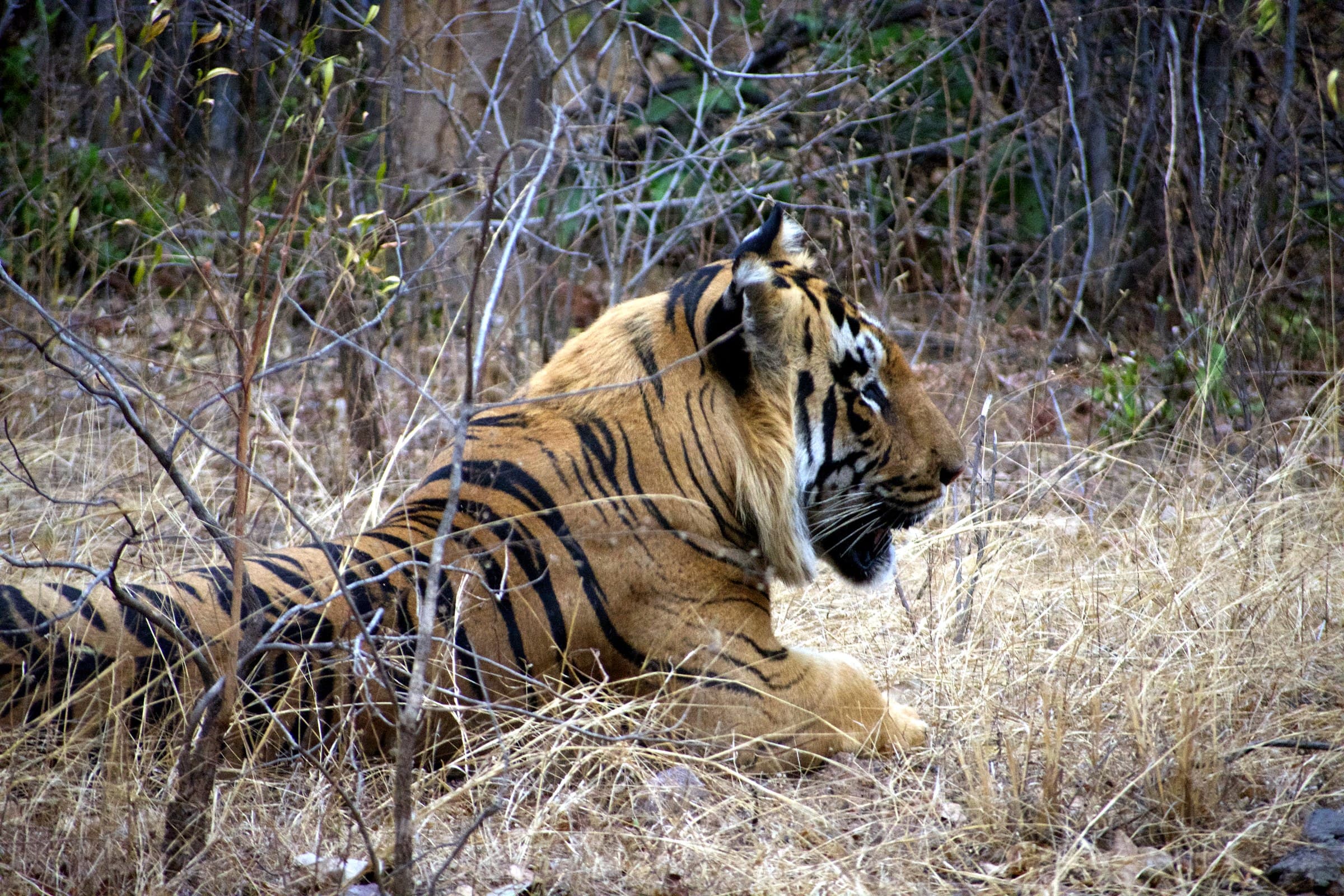
History of Tadoba National Park: From Gond Legend to Tiger Stronghold
Tadoba is named after a Gond deity, was a royal hunting ground for centuries, and became one of Maharashtra's first national parks in 1955. How a modest teak forest became India's most reliable tiger reserve.
Every forest has a story. Tadoba's begins with a man who fought a tiger. Local Gond tradition holds that Taru, a village chief, died in single combat with a tiger near the lake that now bears his name. The community deified him — Taru became "Tadoba", and his shrine on the bank of Tadoba lake is still worshipped by villagers today. The second half of the reserve's official name is simpler: the Andhari river, which threads through these hills before joining the Wainganga system.
The Gond centuries
Long before permits and gypsies, this forest belonged to the Gond kings of Chanda (today's Chandrapur). The walled city they built — its fort ramparts and the Mahakali temple still stand 30 km from Moharli gate — controlled a countryside of teak, bamboo, and tigers. Forests like Tadoba were royal hunting grounds and a source of timber, but the Gond rulers' hunts were episodic; the forest itself stayed largely intact.
Colonial era: timber and trophy
Under British administration the Chanda forests were organised for teak extraction, and tigers moved from being feared neighbours to trophy targets. By the early twentieth century, hunting pressure was severe enough that the colonial forest department itself began imposing restrictions — shooting in the Tadoba block was progressively curtailed in the 1930s, one of the earliest protection moves in the region.
1955: a national park before Project Tiger
India's modern conservation era is usually dated to Project Tiger in 1973, but Tadoba was ahead of it: in 1955 it was declared a national park, among the first in Maharashtra. For decades it stayed small and obscure — a compact core around Tadoba lake, visited by few.
The map changed twice more:
| Year | Event |
|---|---|
| 1955 | Tadoba National Park declared |
| 1986 | Andhari Wildlife Sanctuary created on adjoining forest |
| 1995 | Park + sanctuary combined as the Tadoba-Andhari Tiger Reserve (Project Tiger) |
| 2010 | Large buffer zone notified around the core |
That 1995 merger created today's reserve: a core of roughly 625 sq km wrapped in a buffer that villages, resorts, and — increasingly — tigers share.
The turnaround years
Through the 2000s Tadoba was still a connoisseur's park — good sightings, little infrastructure. Two things changed it. First, protection and prey recovery: tiger numbers roughly doubled from around forty in 2010 to close to a hundred across the wider landscape by the early 2020s. Second, a generation of habituated, camera-famous tigers — none more than Maya, the Pandharpauni tigress whose comfort around vehicles defined a decade of Tadoba photography — turned the park into household news among Indian wildlife travellers.
When core-zone tourism was capped after 2012's nationwide court orders, Tadoba's buffer zones became a template other reserves copied: gates like Agarzari, Junona, Devada-Adegaon and Alizanza opened regulated safaris outside the core, spreading vehicles, revenue, and sightings across a wider area — and keeping the park open through the monsoon when core gates close.
Why the history matters for your safari
- The lake is the heart. Tadoba lake — Taru's lake — anchors the richest tiger territories in the park. Routes around it from Moharli gate sit at the centre of a hundred years of protection.
- Teak and bamboo are the stage. The same timber the Gonds and British valued now gives Tadoba its dry-season visibility — sparse understorey, long sightlines, reliable sightings. See when to visit to use that to your advantage.
- The buffer is the future. Most new tiger territories, the forest department's new activities (boating, kayaking, cycling, camping), and value stays are in the buffer — the newest chapter of the story above.
- The 2026 count. On Buddha Purnima night in 2026, the reserve's waterhole (machan) census recorded 42 tigers among 5,765 wildlife sightings. It's a one-night count at waterholes, so the real population is higher — but it shows a healthy prey base across core and buffer.
Walk it with people who grew up beside it — our packages are led by naturalists from these villages. Tell us your dates and we'll plan your trip.
Plan your trip
Ready to walk the forest?
We'll handle permits, property, and every small thing in between.
Plan my safari